

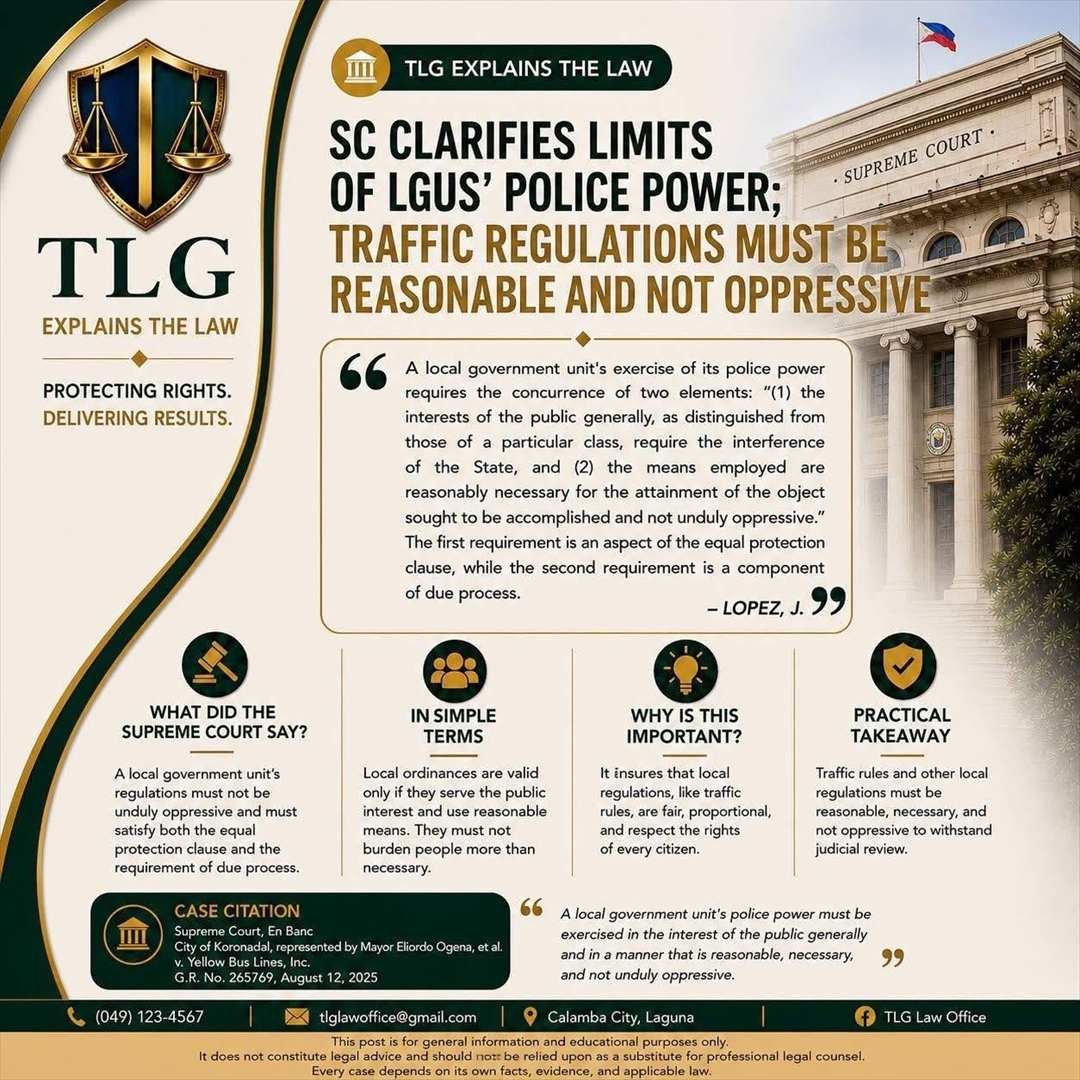
The Supreme Court held that a local government unit's exercise of police power requires two elements: the interests of the public generally — as distinguished from those of a particular class — require the interference of the State, and the means employed are reasonably necessary to accomplish the objective and are not unduly oppressive.
The first requirement is an aspect of the equal protection clause, while the second is a component of due process.
“A local government unit's police power must be exercised in the interest of the public generally and in a manner that is reasonable, necessary, and not unduly oppressive.”
— Lopez, J.
What Did the Supreme Court Decide?
A local government unit's regulations must not be unduly oppressive and must satisfy both the equal protection clause and the requirement of due process.
In Simple Terms
Local ordinances are valid only if they serve the public interest and use reasonable means. They must not burden people more than necessary.
Why Is This Important?
It ensures that local regulations, like traffic rules, are fair, proportional, and respect the rights of every citizen.
Practical Takeaway
Traffic rules and other local regulations must be reasonable, necessary, and not oppressive to withstand judicial review.
Case Citation
City of Koronadal, represented by Mayor Eliordo Ogena, et al. v. Yellow Bus Lines, Inc.
G.R. No. 265769
August 12, 2025
Supreme Court, En Banc
How TLG Can Help
Is a local ordinance, permit requirement, or regulation affecting your business or property unfairly? TLG can assess whether it may be questioned and what remedies are available.
Learn about our Civil Litigation & Dispute Resolution practice →