
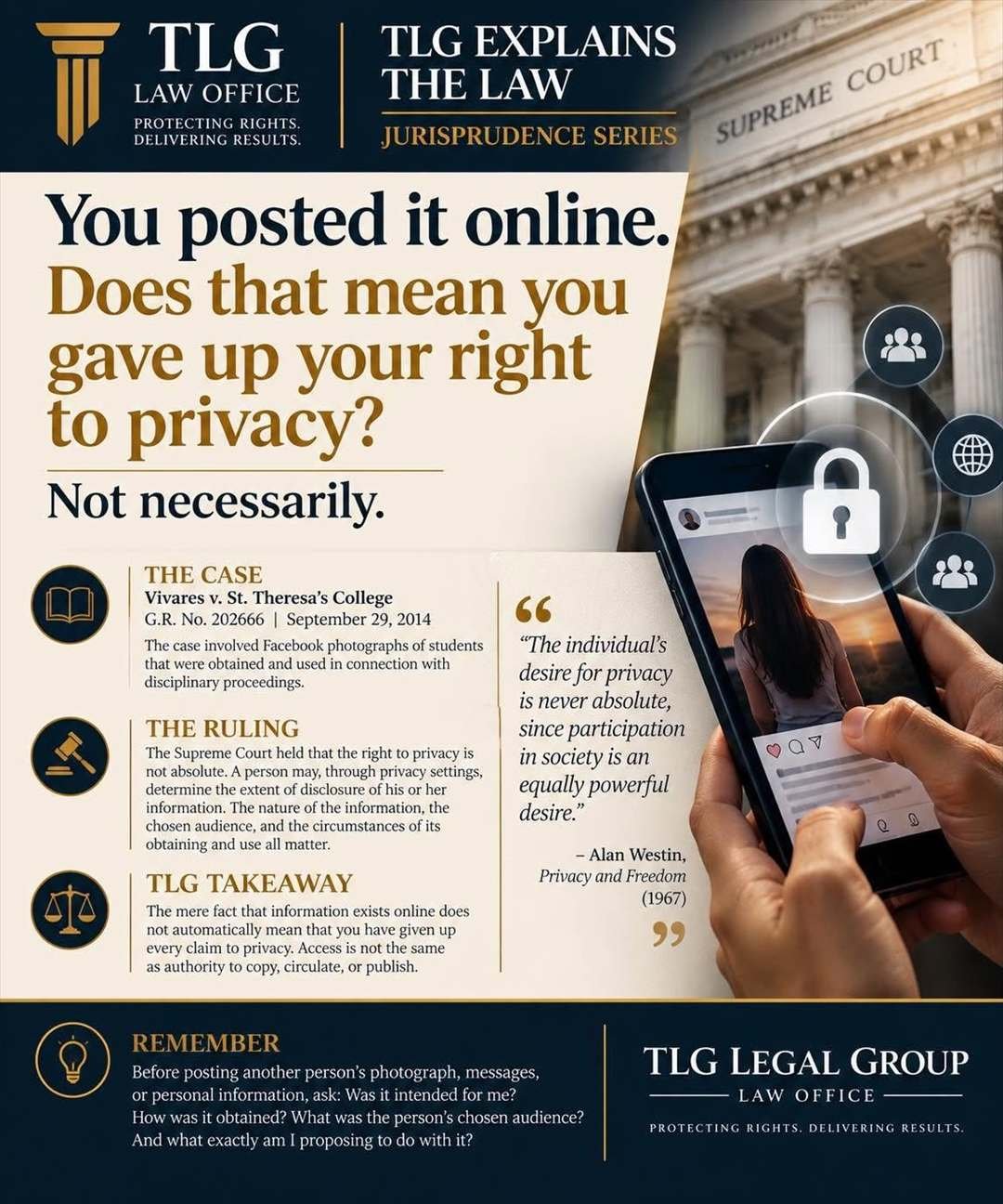
The Supreme Court held that the right to privacy is not absolute — but a person may, through privacy settings, determine the extent of disclosure of his or her information.
“The individual's desire for privacy is never absolute, since participation in society is an equally powerful desire.”
— Alan Westin, Privacy and Freedom (1967)
The Case
The case involved Facebook photographs of students that were obtained and used in connection with disciplinary proceedings.
What Did the Supreme Court Decide?
The Supreme Court held that the right to privacy is not absolute. A person may, through privacy settings, determine the extent of disclosure of his or her information. The nature of the information, the chosen audience, and the circumstances of its obtaining and use all matter.
In Simple Terms
Posting something online does not automatically make it public property. Who you shared it with, and how it was obtained, still matter.
Why Is This Important?
It guides how courts weigh privacy in social media, where people share information with chosen audiences rather than with the whole world.
Remember
Before posting another person's photograph, messages, or personal information, ask: Was it intended for me? How was it obtained? What was the person's chosen audience? And what exactly am I proposing to do with it?
Practical Takeaway
The mere fact that information exists online does not automatically mean that you have given up every claim to privacy. Access is not the same as authority to copy, circulate, or publish.
Case Citation
Vivares v. St. Theresa's College
G.R. No. 202666
September 29, 2014
How TLG Can Help
Were your photos or messages shared without your consent, or are you being accused of sharing someone else's? TLG can explain your rights and the remedies available.
Learn about our Civil Litigation & Dispute Resolution practice →