

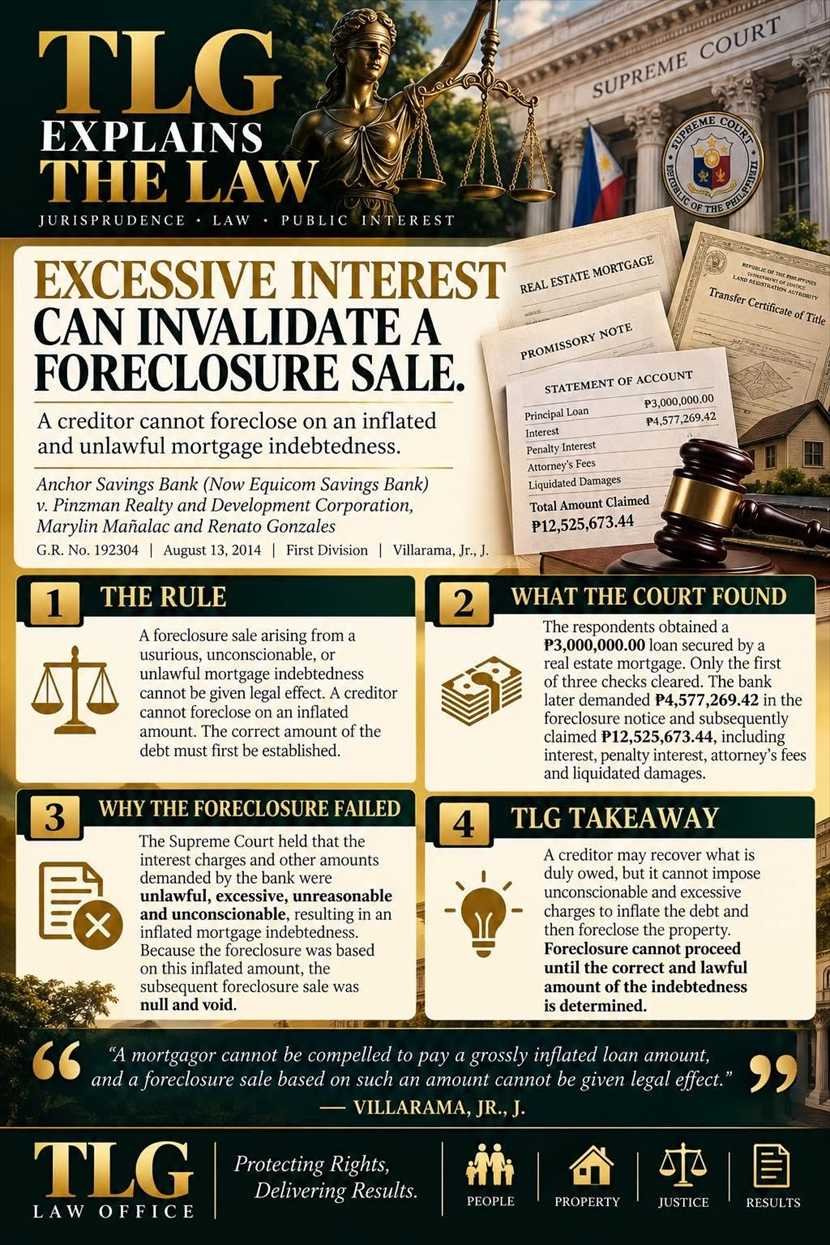
A creditor cannot foreclose on an inflated and unlawful mortgage indebtedness. The Supreme Court held that a foreclosure sale based on unconscionable charges was null and void.
“A mortgagor cannot be compelled to pay a grossly inflated loan amount, and a foreclosure sale based on such an amount cannot be given legal effect.”
— Villarama, Jr., J.
The Rule
A foreclosure sale arising from a usurious, unconscionable, or unlawful mortgage indebtedness cannot be given legal effect. A creditor cannot foreclose on an inflated amount. The correct amount of the debt must first be established.
What the Court Found
The respondents obtained a ₱3,000,000.00 loan secured by a real estate mortgage. Only the first of three checks cleared. The bank later demanded ₱4,577,269.42 in the foreclosure notice and subsequently claimed ₱12,525,673.44, including interest, penalty interest, attorney's fees, and liquidated damages.
What Did the Supreme Court Decide?
The Supreme Court held that the interest charges and other amounts demanded by the bank were unlawful, excessive, unreasonable, and unconscionable, resulting in an inflated mortgage indebtedness. Because the foreclosure was based on this inflated amount, the subsequent foreclosure sale was null and void.
In Simple Terms
A lender cannot pile on excessive charges and then foreclose for the inflated total. The true, lawful amount of the debt must be determined first.
Why Is This Important?
It protects borrowers from losing their property over amounts they do not legally owe.
Practical Takeaway
A creditor may recover what is duly owed, but it cannot impose unconscionable and excessive charges to inflate the debt and then foreclose the property. Foreclosure cannot proceed until the correct and lawful amount of the indebtedness is determined.
Case Citation
Anchor Savings Bank (now Equicom Savings Bank) v. Pinzman Realty and Development Corporation, Marylin Mañalac and Renato Gonzales
G.R. No. 192304
August 13, 2014
First Division
Villarama, Jr., J.
How TLG Can Help
Is your lender demanding far more than you borrowed, or threatening foreclosure? TLG can review the loan, the interest charged, and the foreclosure papers.
Learn about our Property & Real Estate practice →
Next: Reduced Workdays and Worker Rotation Without Consent Amount to Constructive Dismissal