

The Supreme Court held that a general stipulation allowing foreclosure does not, by itself, give the mortgagee the special authority required to sell the property extrajudicially.
The Rule
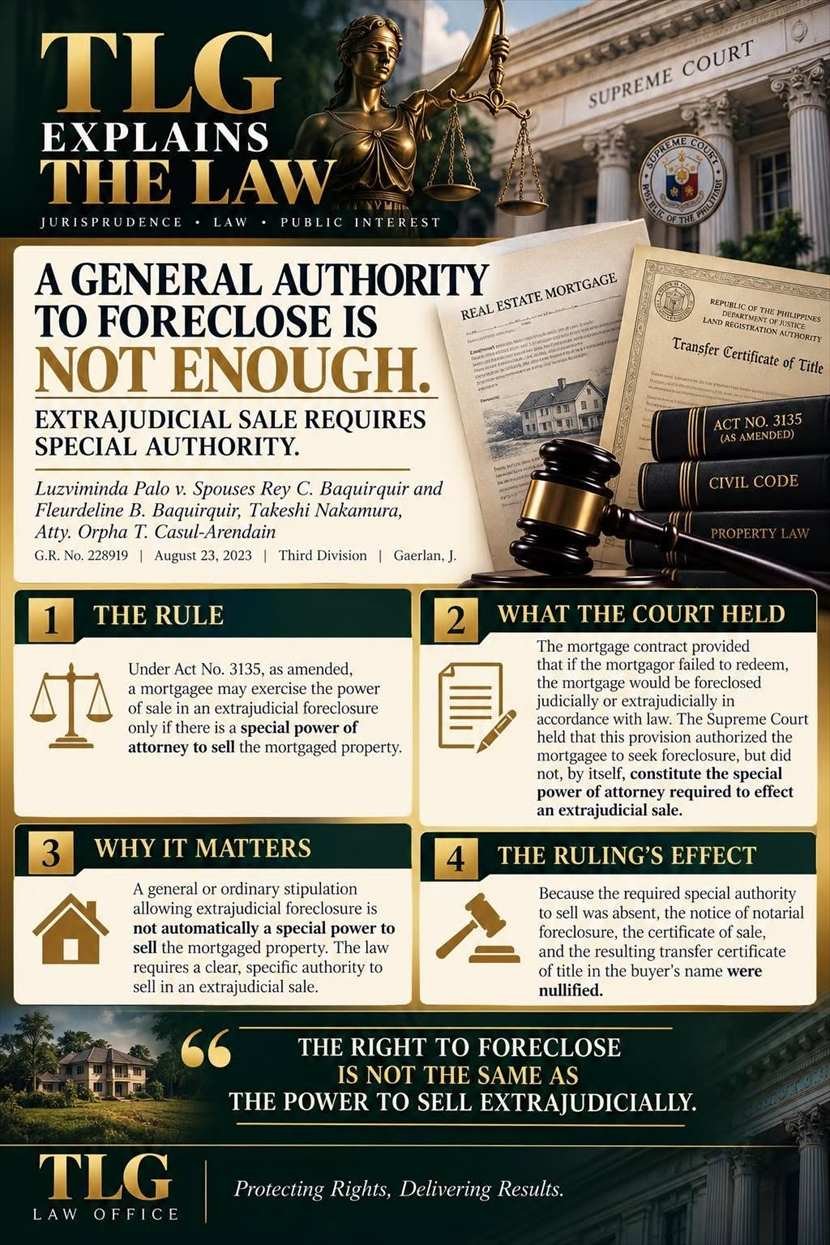
Under Act No. 3135, as amended, a mortgagee may exercise the power of sale in an extrajudicial foreclosure only if there is a special power of attorney to sell the mortgaged property.
What Did the Supreme Court Decide?
The mortgage contract provided that if the mortgagor failed to redeem, the mortgage would be foreclosed judicially or extrajudicially in accordance with law. The Supreme Court held that this provision authorized the mortgagee to seek foreclosure, but did not, by itself, constitute the special power of attorney required to effect an extrajudicial sale.
In Simple Terms
A mortgage that says the property may be foreclosed does not automatically allow the lender to sell it without going to court. That needs a clear, specific authority to sell.
Why Is This Important?
A general or ordinary stipulation allowing extrajudicial foreclosure is not automatically a special power to sell the mortgaged property. The law requires a clear, specific authority to sell in an extrajudicial sale.
The Ruling's Effect
Because the required special authority to sell was absent, the notice of notarial foreclosure, the certificate of sale, and the resulting transfer certificate of title in the buyer's name were nullified.
Practical Takeaway
The right to foreclose is not the same as the power to sell extrajudicially.
Case Citation
Luzviminda Palo v. Spouses Rey C. Baquirquir and Fleurdeline B. Baquirquir, Takeshi Nakamura, Atty. Orpha T. Casul-Arendain
G.R. No. 228919
August 23, 2023
Third Division
Gaerlan, J.
How TLG Can Help
Facing foreclosure, or did you lose property through an extrajudicial sale? TLG can review the mortgage, the notices, and the sale to see whether they can be challenged.
Learn about our Property & Real Estate practice →