

A clean title is important — but when circumstances should have put the buyer on inquiry, the Supreme Court held that relying on the title alone is not enough to be considered a buyer in good faith.
The Rule
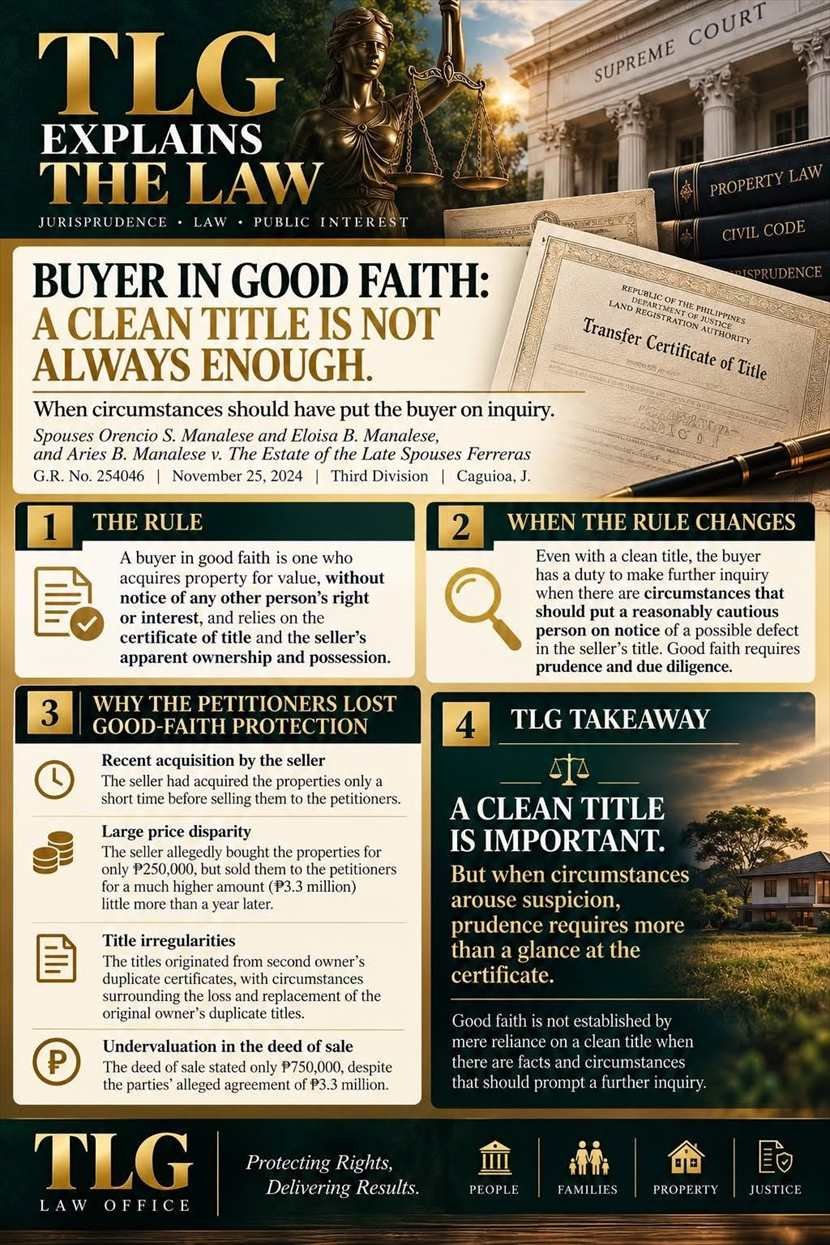
A buyer in good faith is one who acquires property for value, without notice of any other person's right or interest, and relies on the certificate of title and the seller's apparent ownership and possession.
When the Rule Changes
Even with a clean title, the buyer has a duty to make further inquiry when there are circumstances that should put a reasonably cautious person on notice of a possible defect in the seller's title. Good faith requires prudence and due diligence.
What Did the Supreme Court Decide?
The petitioners lost good-faith protection because of these circumstances:
- Recent acquisition by the seller — the seller had acquired the properties only a short time before selling them to the petitioners.
- Large price disparity — the seller allegedly bought the properties for only ₱250,000, but sold them to the petitioners for a much higher amount (₱3.3 million) a little more than a year later.
- Title irregularities — the titles originated from second owner's duplicate certificates, with circumstances surrounding the loss and replacement of the original owner's duplicate titles.
- Undervaluation in the deed of sale — the deed of sale stated only ₱750,000, despite the parties' alleged agreement of ₱3.3 million.
In Simple Terms
Checking the title is the first step, not the only one. If the deal shows warning signs, you are expected to investigate further before buying.
Why Is This Important?
It protects true owners from transactions built on questionable titles, and it reminds buyers that unusual circumstances call for more diligence.
Practical Takeaway
A clean title is important. But when circumstances arouse suspicion, prudence requires more than a glance at the certificate. Good faith is not established by mere reliance on a clean title when there are facts and circumstances that should prompt a further inquiry.
Case Citation
Spouses Orencio S. Manalese and Eloisa B. Manalese, and Aries B. Manalese v. The Estate of the Late Spouses Ferreras
G.R. No. 254046
November 25, 2024
Third Division
Caguioa, J.
How TLG Can Help
Buying land or a house? Have a TLG lawyer review the title, its history, and the deal before you pay — it costs far less than a court case later.
Learn about our Property & Real Estate practice →
Next: What Happens When a Resignation Is Signed Through Deceit?