

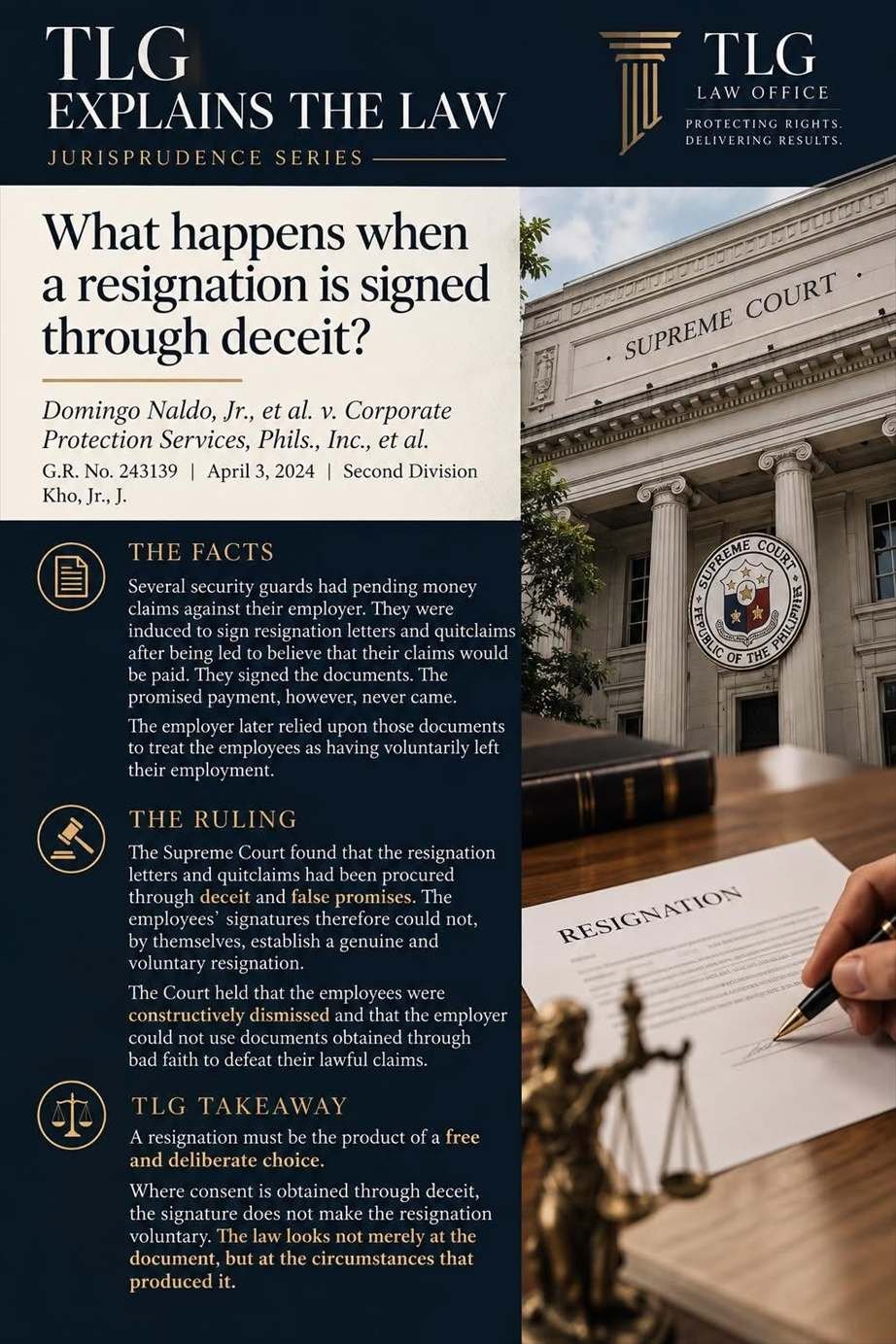
The Supreme Court held that resignation letters and quitclaims procured through deceit and false promises cannot, by themselves, establish a genuine and voluntary resignation.
The Facts
Several security guards had pending money claims against their employer. They were induced to sign resignation letters and quitclaims after being led to believe that their claims would be paid. They signed the documents. The promised payment, however, never came.
The employer later relied upon those documents to treat the employees as having voluntarily left their employment.
What Did the Supreme Court Decide?
The Supreme Court found that the resignation letters and quitclaims had been procured through deceit and false promises. The employees' signatures therefore could not, by themselves, establish a genuine and voluntary resignation. The Court held that the employees were constructively dismissed and that the employer could not use documents obtained through bad faith to defeat their lawful claims.
In Simple Terms
A signed resignation letter is not the end of the story. If you were tricked into signing it, the law can treat you as dismissed.
Why Is This Important?
It prevents employers from using signatures obtained through false promises to escape their obligations to employees.
Practical Takeaway
A resignation must be the product of a free and deliberate choice. Where consent is obtained through deceit, the signature does not make the resignation voluntary. The law looks not merely at the document, but at the circumstances that produced it.
Case Citation
Domingo Naldo, Jr., et al. v. Corporate Protection Services, Phils., Inc., et al.
G.R. No. 243139
April 3, 2024
Second Division
Kho, Jr., J.
How TLG Can Help
Were you made to sign a resignation or quitclaim in exchange for a promise that was never kept? Bring the documents to a consultation and we'll review your options.
Learn about our Labor & Employment practice →
Next: A General Authority to Foreclose Is Not Enough: Extrajudicial Sale Requires Special Authority