

The Supreme Court held that turning 60 gives an employee the option to retire, but it does not, by itself, mean that the employee has chosen to retire.
The Facts
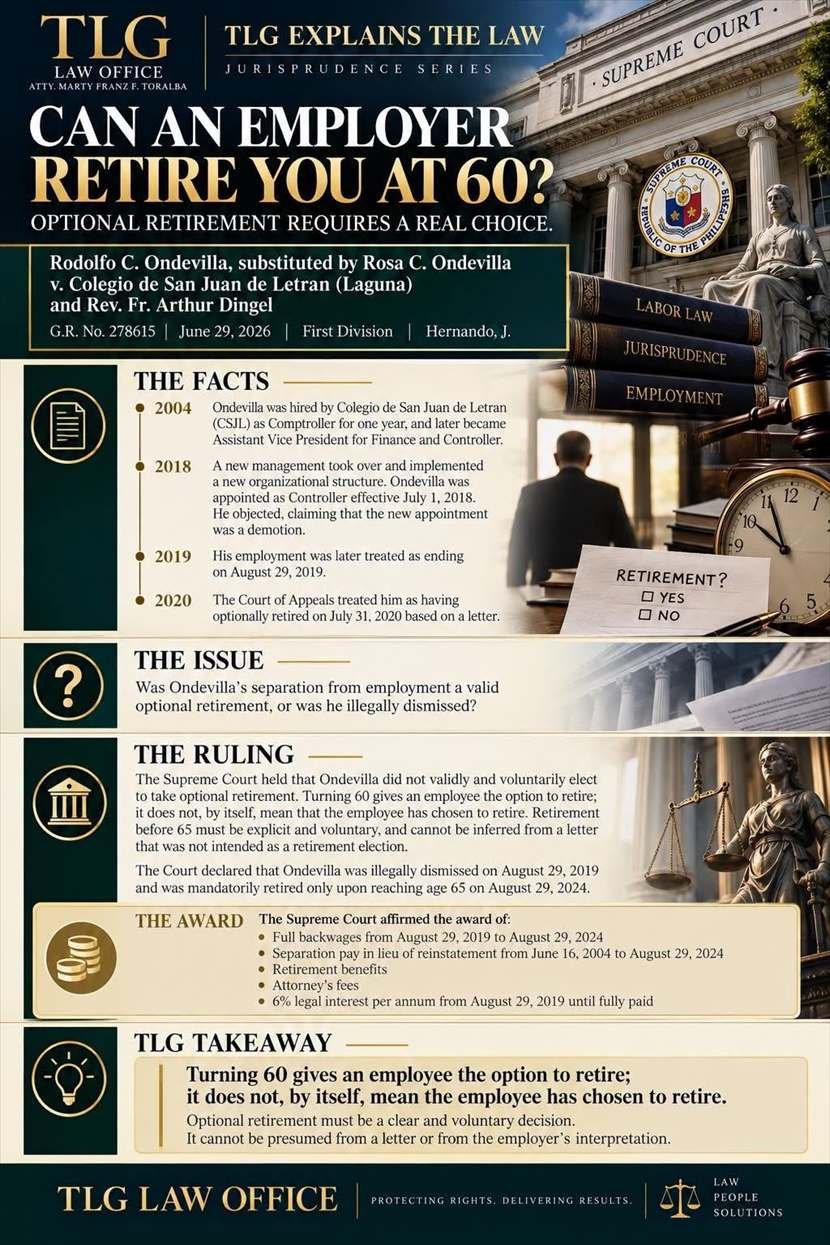
2004 — Ondevilla was hired by Colegio de San Juan de Letran (CSJL) as Comptroller for one year, and later became Assistant Vice President for Finance and Controller.
2018 — A new management took over and implemented a new organizational structure. Ondevilla was appointed as Controller effective July 1, 2018. He objected, claiming that the new appointment was a demotion.
2019 — His employment was later treated as ending on August 29, 2019.
2020 — The Court of Appeals treated him as having optionally retired on July 31, 2020, based on a letter.
The Issue
Was Ondevilla's separation from employment a valid optional retirement, or was he illegally dismissed?
What Did the Supreme Court Decide?
The Supreme Court held that Ondevilla did not validly and voluntarily elect to take optional retirement. Retirement before 65 must be explicit and voluntary, and cannot be inferred from a letter that was not intended as a retirement election. The Court declared that Ondevilla was illegally dismissed on August 29, 2019, and was mandatorily retired only upon reaching age 65 on August 29, 2024.
In Simple Terms
Reaching 60 only gives you the right to choose early retirement. Your employer cannot make that choice for you, and a letter you wrote for another purpose cannot be treated as your decision to retire.
Why Is This Important?
It protects employees from being treated as retired on the basis of the employer's interpretation, and it confirms that an employee's own clear and voluntary decision is required.
The Award
The Supreme Court affirmed the award of:
• Full backwages from August 29, 2019 to August 29, 2024
• Separation pay in lieu of reinstatement from June 16, 2004 to August 29, 2024
• Retirement benefits
• Attorney's fees
• 6% legal interest per annum from August 29, 2019 until fully paid
Practical Takeaway
Turning 60 gives an employee the option to retire; it does not, by itself, mean the employee has chosen to retire. Optional retirement must be a clear and voluntary decision. It cannot be presumed from a letter or from the employer's interpretation.
Case Citation
Rodolfo C. Ondevilla, substituted by Rosa C. Ondevilla v. Colegio de San Juan de Letran (Laguna) and Rev. Fr. Arthur Dingel
G.R. No. 278615
June 29, 2026
First Division
Hernando, J.
How TLG Can Help
Were you told you have “retired” when you never chose to? Or are you an employer planning a retirement program? A TLG lawyer can review the documents and explain your rights and obligations.
Learn about our Labor & Employment practice →
Next: The Insurer May Recover What It Paid From the Person at Fault