

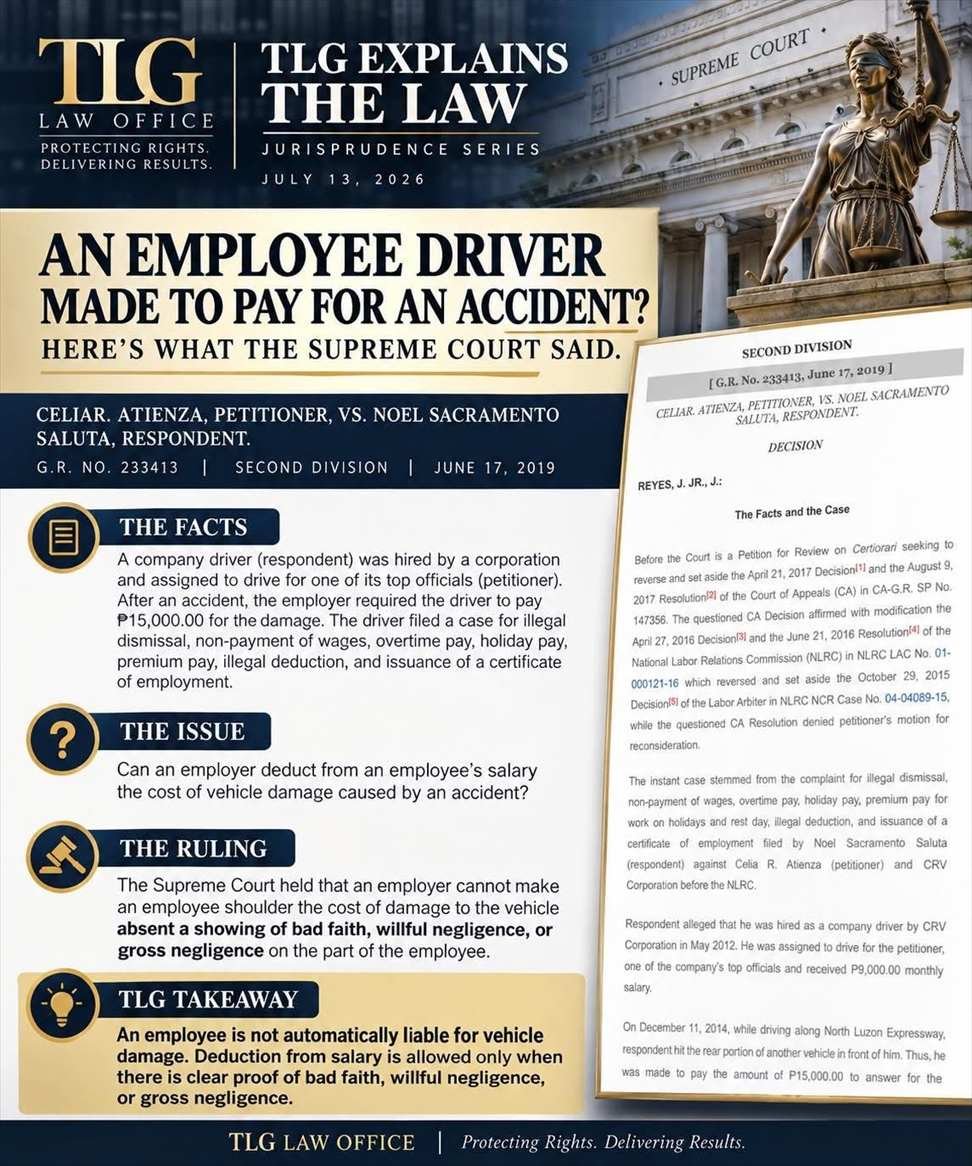
The Supreme Court held that an employer cannot make an employee shoulder the cost of damage to a vehicle absent a showing of bad faith, willful negligence, or gross negligence on the part of the employee.
The Facts
A company driver (respondent) was hired by a corporation and assigned to drive for one of its top officials (petitioner). After an accident, the employer required the driver to pay ₱15,000.00 for the damage. The driver filed a case for illegal dismissal, non-payment of wages, overtime pay, holiday pay, premium pay, illegal deduction, and issuance of a certificate of employment.
The Issue
Can an employer deduct from an employee's salary the cost of vehicle damage caused by an accident?
What Did the Supreme Court Decide?
The Supreme Court held that an employer cannot make an employee shoulder the cost of damage to the vehicle absent a showing of bad faith, willful negligence, or gross negligence on the part of the employee.
In Simple Terms
An accident on the job does not automatically make you pay for the damage. Your employer must first show bad faith or serious negligence on your part.
Why Is This Important?
It protects employees — especially company drivers — from salary deductions for ordinary accidents that happen in the course of work.
Practical Takeaway
An employee is not automatically liable for vehicle damage. Deduction from salary is allowed only when there is clear proof of bad faith, willful negligence, or gross negligence.
Case Citation
Celia R. Atienza v. Noel Sacramento Saluta
G.R. No. 233413
June 17, 2019
Second Division
Reyes, J. Jr., J.
How TLG Can Help
Were you charged or had your salary deducted for damage at work? Or are you an employer setting rules for company vehicles? A TLG lawyer can explain what the law allows.
Learn about our Labor & Employment practice →