

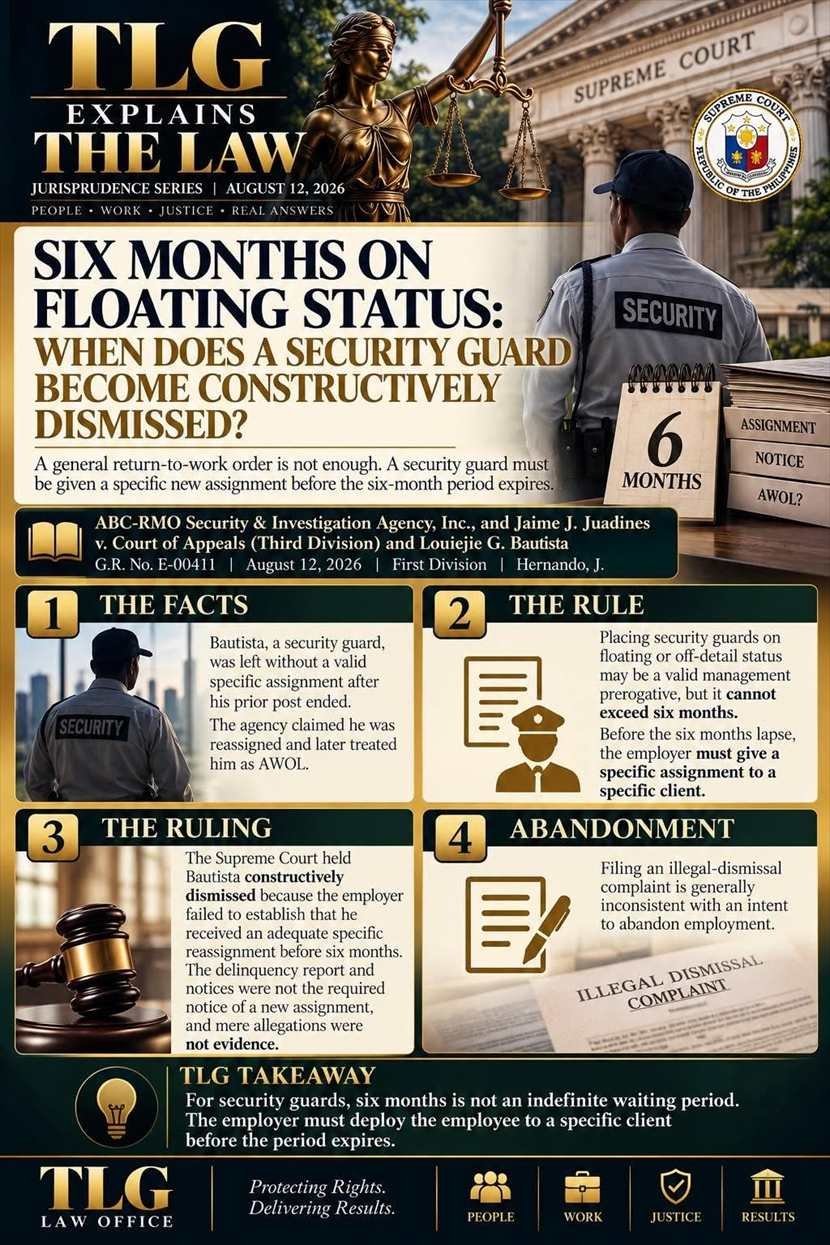
A general return-to-work order is not enough. The Supreme Court held that a security guard must be given a specific new assignment before the six-month period of floating status expires.
The Facts
Bautista, a security guard, was left without a valid specific assignment after his prior post ended.
The agency claimed he was reassigned and later treated him as AWOL.
The Rule
Placing security guards on floating or off-detail status may be a valid management prerogative, but it cannot exceed six months. Before the six months lapse, the employer must give a specific assignment to a specific client.
What Did the Supreme Court Decide?
The Supreme Court held Bautista constructively dismissed because the employer failed to establish that he received an adequate specific reassignment before six months. The delinquency report and notices were not the required notice of a new assignment, and mere allegations were not evidence.
In Simple Terms
An agency may keep a guard on floating status only for a limited time. If six months pass without a real, specific post for a specific client, the guard is treated as dismissed — general notices are not enough.
Why Is This Important?
It prevents the waiting period between posts from becoming indefinite, and it requires employers to prove an actual reassignment rather than simply allege one.
What About Abandonment?
Filing an illegal-dismissal complaint is generally inconsistent with an intent to abandon employment.
Practical Takeaway
For security guards, six months is not an indefinite waiting period. The employer must deploy the employee to a specific client before the period expires.
Case Citation
ABC-RMO Security & Investigation Agency, Inc., and Jaime J. Juadines v. Court of Appeals (Third Division) and Louiejie G. Bautista
G.R. No. E-00411
August 12, 2026
First Division
Hernando, J.
How TLG Can Help
Are you a security guard who has been on floating status for months, or an agency that needs to reassign personnel correctly? Talk to a TLG lawyer before the six-month period runs out.
Learn about our Labor & Employment practice →
Next: Can an Employer Retire You at 60? Optional Retirement Requires a Real Choice