
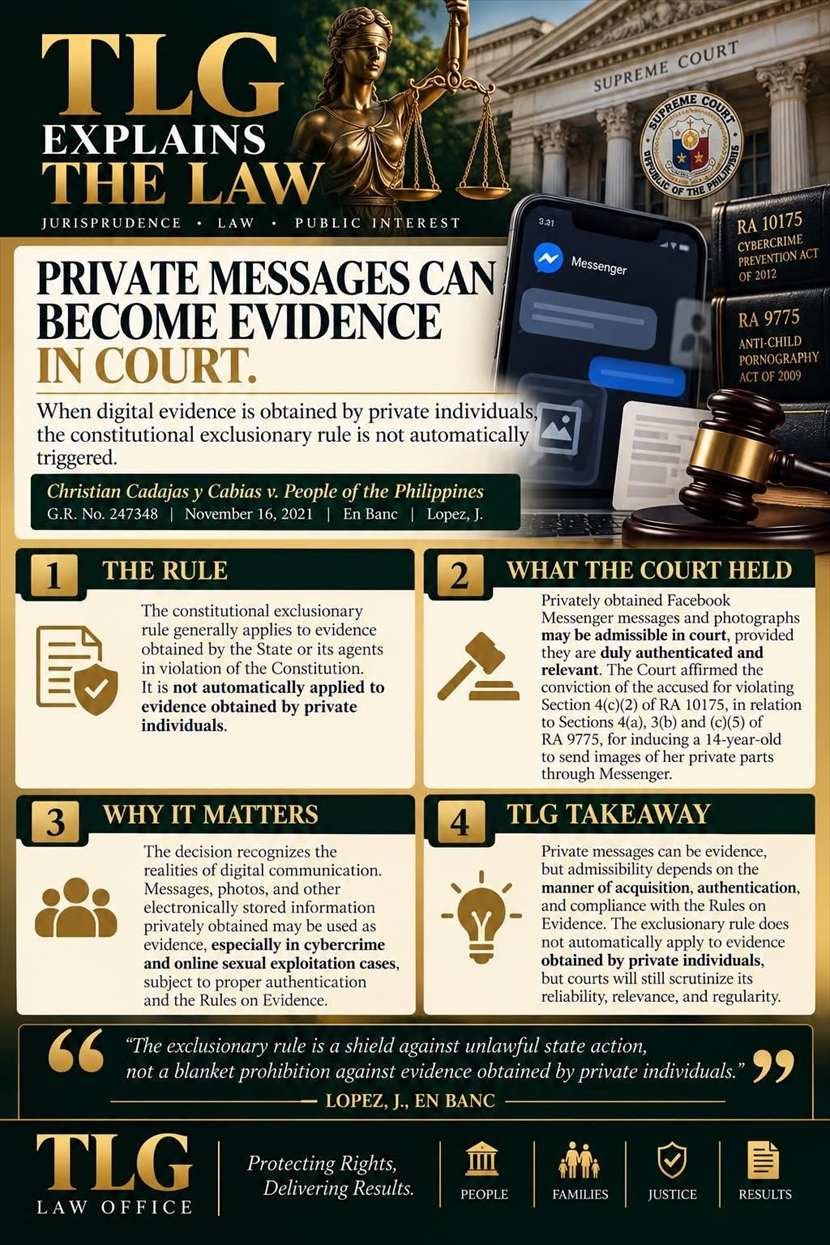
When digital evidence is obtained by private individuals, the constitutional exclusionary rule is not automatically triggered. The Supreme Court En Banc held that privately obtained Facebook Messenger messages and photographs may be admissible in court.
“The exclusionary rule is a shield against unlawful state action, not a blanket prohibition against evidence obtained by private individuals.”
— Lopez, J., En Banc
The Rule
The constitutional exclusionary rule generally applies to evidence obtained by the State or its agents in violation of the Constitution. It is not automatically applied to evidence obtained by private individuals.
What Did the Supreme Court Decide?
Privately obtained Facebook Messenger messages and photographs may be admissible in court, provided they are duly authenticated and relevant. The Court affirmed the conviction of the accused for violating Section 4(c)(2) of RA 10175, in relation to Sections 4(a), 3(b) and (c)(5) of RA 9775, for inducing a 14-year-old to send images of her private parts through Messenger.
In Simple Terms
Messages and photos that a private person obtains — not the police — can be used as evidence, as long as they are properly authenticated and relevant to the case.
Why Is This Important?
The decision recognizes the realities of digital communication. Messages, photos, and other electronically stored information privately obtained may be used as evidence, especially in cybercrime and online sexual exploitation cases, subject to proper authentication and the Rules on Evidence.
Practical Takeaway
Private messages can be evidence, but admissibility depends on the manner of acquisition, authentication, and compliance with the Rules on Evidence. The exclusionary rule does not automatically apply to evidence obtained by private individuals, but courts will still scrutinize its reliability, relevance, and regularity.
Case Citation
Christian Cadajas y Cabias v. People of the Philippines
G.R. No. 247348
November 16, 2021
En Banc
Lopez, J.
How TLG Can Help
Whether you need to preserve messages as evidence or you are facing a case built on screenshots, how digital evidence is obtained and authenticated matters. Consult a TLG lawyer early.
Learn about our Criminal Litigation practice →
Next: An Employee Driver Made to Pay for an Accident? Here's What the Supreme Court Said