

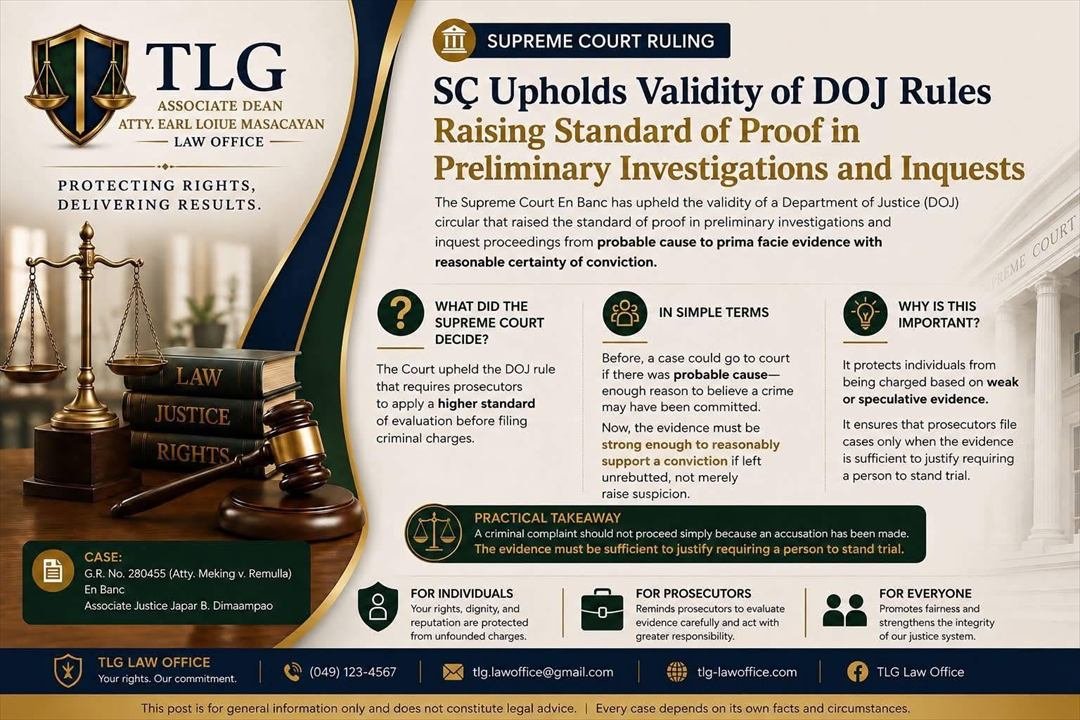
The Supreme Court En Banc has upheld the validity of a Department of Justice (DOJ) circular that raised the standard of proof in preliminary investigations and inquest proceedings — from probable cause to prima facie evidence with reasonable certainty of conviction.
What Did the Supreme Court Decide?
The Court upheld the DOJ rule that requires prosecutors to apply a higher standard of evaluation before filing criminal charges.
In Simple Terms
Before, a case could go to court if there was probable cause — enough reason to believe a crime may have been committed. Now, the evidence must be strong enough to reasonably support a conviction if left unrebutted, not merely raise suspicion.
Why Is This Important?
It protects individuals from being charged based on weak or speculative evidence, and ensures that prosecutors file cases only when the evidence is sufficient to justify requiring a person to stand trial.
Practical Takeaway
A criminal complaint should not proceed simply because an accusation has been made. The evidence must be sufficient to justify requiring a person to stand trial.
What This Means for You
- For individuals: Your rights, dignity, and reputation are protected from unfounded charges.
- For prosecutors: A reminder to evaluate evidence carefully and act with greater responsibility.
- For everyone: Promotes fairness and strengthens the integrity of our justice system.
Case Citation
G.R. No. 280455
Atty. Meking v. Remulla
En Banc
Associate Justice Japar B. Dimaampao
How TLG Can Help
If you received a subpoena for a preliminary investigation, your counter-affidavit is your first and best opportunity to show the evidence is insufficient. Talk to a lawyer before you file it.
Learn about our Criminal Litigation practice →
Next: Self-Defense Claim Rejected When the Version of Events Contradicted Common Human Experience