

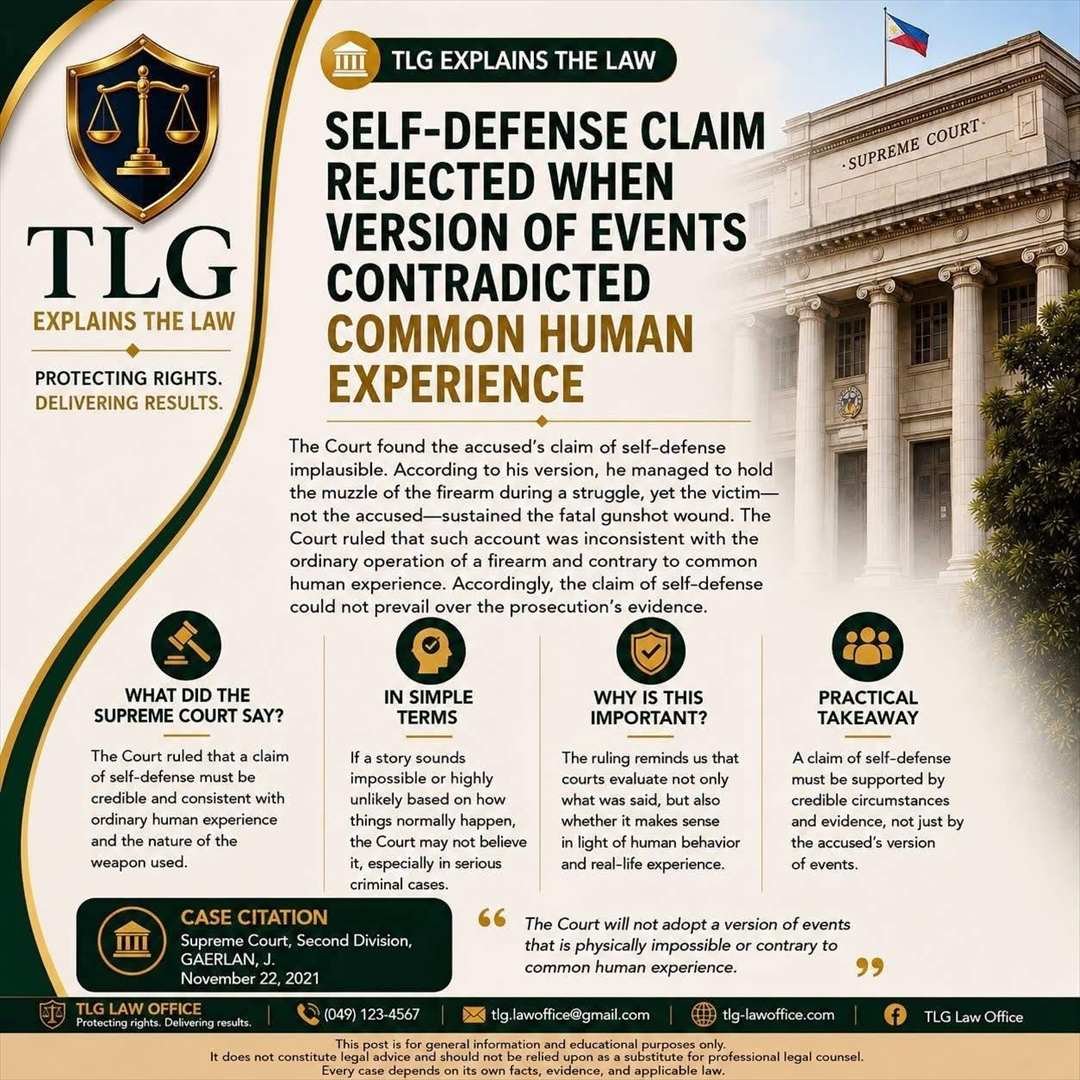
The Court found the accused's claim of self-defense implausible. According to his version, he managed to hold the muzzle of the firearm during a struggle, yet the victim — not the accused — sustained the fatal gunshot wound. The Court ruled that such an account was inconsistent with the ordinary operation of a firearm and contrary to common human experience. Accordingly, the claim of self-defense could not prevail over the prosecution's evidence.
“The Court will not adopt a version of events that is physically impossible or contrary to common human experience.”
— Supreme Court
What Did the Supreme Court Decide?
The Court ruled that a claim of self-defense must be credible and consistent with ordinary human experience and the nature of the weapon used.
In Simple Terms
If a story sounds impossible or highly unlikely based on how things normally happen, the Court may not believe it — especially in serious criminal cases.
Why Is This Important?
The ruling reminds us that courts evaluate not only what was said, but also whether it makes sense in light of human behavior and real-life experience.
Practical Takeaway
A claim of self-defense must be supported by credible circumstances and evidence, not just by the accused's version of events.
Case Citation
Supreme Court, Second Division
Gaerlan, J.
November 22, 2021
How TLG Can Help
In criminal cases, a defense is only as strong as the evidence and preparation behind it. TLG prepares every defense with careful attention to the facts, the physical evidence, and how a court will weigh them.
Learn about our Criminal Litigation practice →
Next: Paternity Must Be Proven to Secure a Conviction for Economic Abuse Under the Anti-VAWC Law