

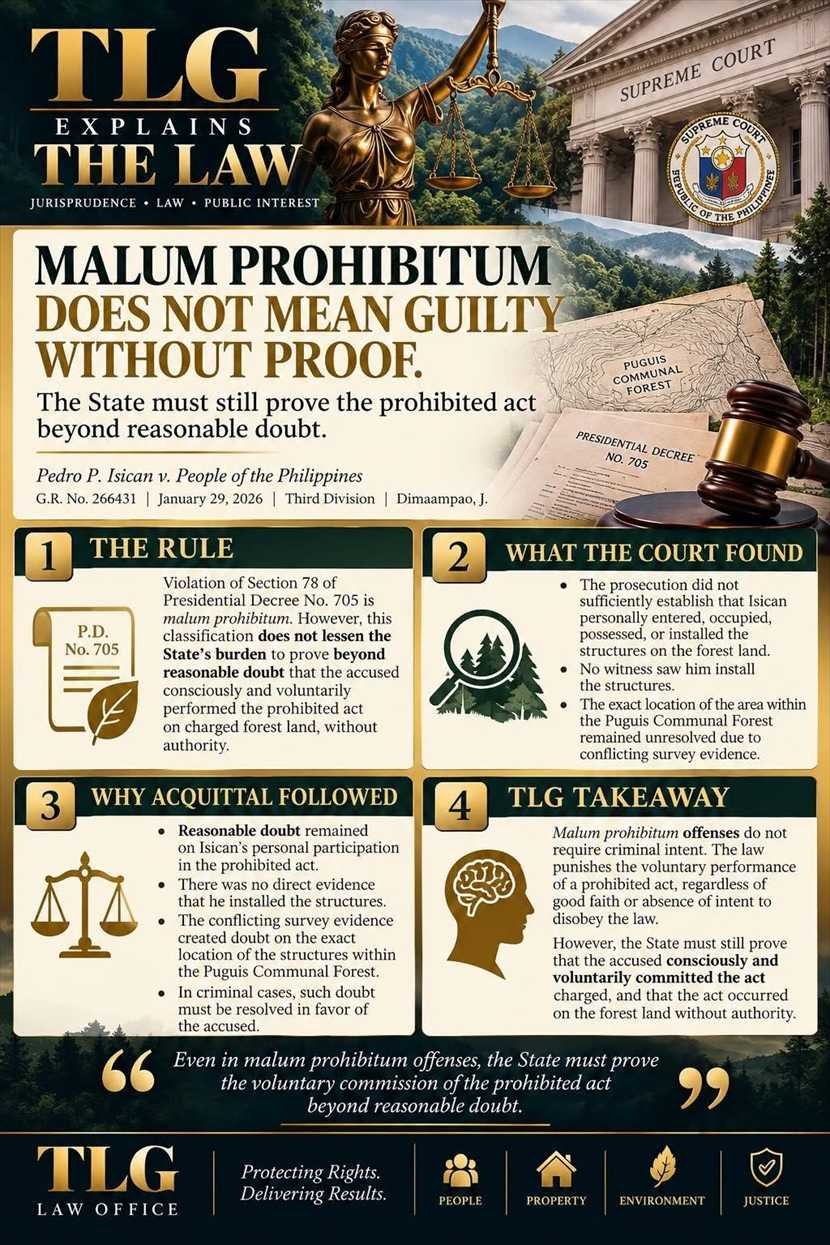
The State must still prove the prohibited act beyond reasonable doubt. The Supreme Court acquitted an accused charged under Section 78 of Presidential Decree No. 705 because his participation in the prohibited act was not proven.
“Even in malum prohibitum offenses, the State must prove the voluntary commission of the prohibited act beyond reasonable doubt.”
The Rule
Violation of Section 78 of Presidential Decree No. 705 is malum prohibitum. However, this classification does not lessen the State's burden to prove beyond reasonable doubt that the accused consciously and voluntarily performed the prohibited act on charged forest land, without authority.
What Did the Supreme Court Decide?
The prosecution did not sufficiently establish that Isican personally entered, occupied, possessed, or installed the structures on the forest land. No witness saw him install the structures, and the exact location of the area within the Puguis Communal Forest remained unresolved due to conflicting survey evidence.
In Simple Terms
For some offenses, it doesn't matter whether you intended to break the law. But the prosecution must still prove that you actually did the prohibited act.
Why Is This Important?
Reasonable doubt remained on Isican's personal participation in the prohibited act. There was no direct evidence that he installed the structures, and the conflicting survey evidence created doubt on the exact location of the structures within the Puguis Communal Forest. In criminal cases, such doubt must be resolved in favor of the accused.
Practical Takeaway
Malum prohibitum offenses do not require criminal intent. The law punishes the voluntary performance of a prohibited act, regardless of good faith or absence of intent to disobey the law. However, the State must still prove that the accused consciously and voluntarily committed the act charged, and that the act occurred on the forest land without authority.
Case Citation
Pedro P. Isican v. People of the Philippines
G.R. No. 266431
January 29, 2026
Third Division
Dimaampao, J.
How TLG Can Help
Facing a charge under a special law, such as forestry, environmental, or regulatory offenses? TLG can examine whether the evidence actually proves your participation.
Learn about our Criminal Litigation practice →
Next: Buyer in Good Faith: A Clean Title Is Not Always Enough