
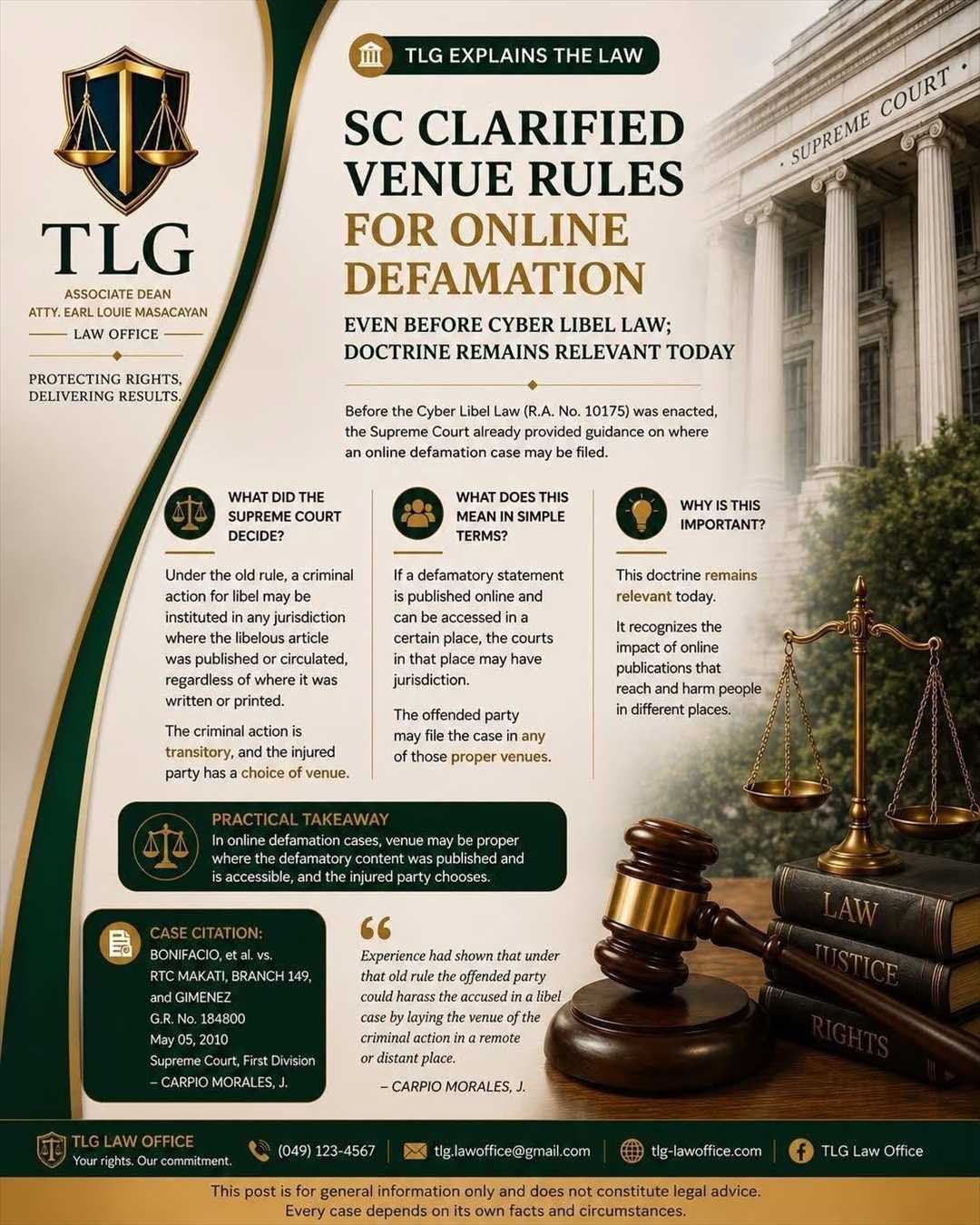
Before the Cybercrime Prevention Act (R.A. No. 10175) was enacted, the Supreme Court already provided guidance on where an online defamation case may be filed. That doctrine remains relevant today.
“Experience had shown that under that old rule the offended party could harass the accused in a libel case by laying the venue of the criminal action in a remote or distant place.”
— Carpio Morales, J.
What Did the Supreme Court Decide?
Under the old rule, a criminal action for libel may be instituted in any jurisdiction where the libelous article was published or circulated, regardless of where it was written or printed. The criminal action is transitory, and the injured party has a choice of venue.
In Simple Terms
If a defamatory statement is published online and can be accessed in a certain place, the courts in that place may have jurisdiction. The offended party may file the case in any of those proper venues.
Why Is This Important?
This doctrine remains relevant today. It recognizes the impact of online publications that reach and harm people in different places.
Practical Takeaway
In online defamation cases, venue may be proper where the defamatory content was published and is accessible, and the injured party chooses.
Case Citation
Bonifacio, et al. v. RTC Makati, Branch 149, and Gimenez
G.R. No. 184800
May 5, 2010
Supreme Court, First Division
Carpio Morales, J.
How TLG Can Help
Were you defamed online, or are you facing a libel or cyber libel complaint? Venue, timing, and evidence all matter. A TLG lawyer can explain your options.
Learn about our Criminal Litigation practice →