
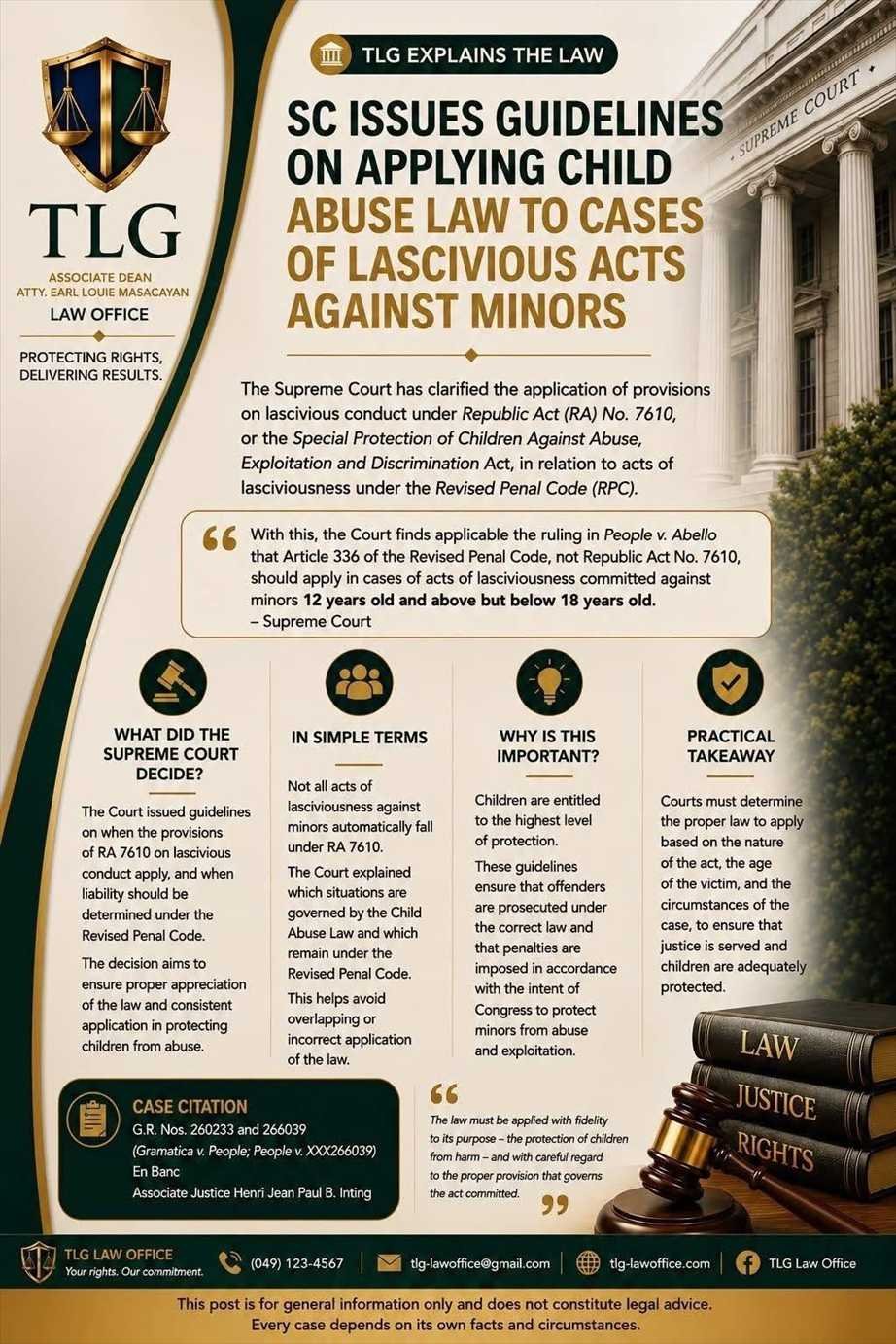
The Supreme Court has clarified the application of provisions on lascivious conduct under Republic Act (RA) No. 7610 — the Special Protection of Children Against Abuse, Exploitation and Discrimination Act — in relation to acts of lasciviousness under the Revised Penal Code (RPC).
“With this, the Court finds applicable the ruling in People v. Abello that Article 336 of the Revised Penal Code, not Republic Act No. 7610, should apply in cases of acts of lasciviousness committed against minors 12 years old and above but below 18 years old.”
— Supreme Court
What Did the Supreme Court Decide?
The Court issued guidelines on when the provisions of RA 7610 on lascivious conduct apply, and when liability should be determined under the Revised Penal Code. The decision aims to ensure proper appreciation of the law and consistent application in protecting children from abuse.
In Simple Terms
Not all acts of lasciviousness against minors automatically fall under RA 7610. The Court explained which situations are governed by the Child Abuse Law and which remain under the Revised Penal Code. This helps avoid overlapping or incorrect application of the law.
Why Is This Important?
Children are entitled to the highest level of protection. These guidelines ensure that offenders are prosecuted under the correct law and that penalties are imposed in accordance with the intent of Congress to protect minors from abuse and exploitation.
Practical Takeaway
Courts must determine the proper law to apply based on the nature of the act, the age of the victim, and the circumstances of the case — to ensure that justice is served and children are adequately protected.
Case Citation
G.R. Nos. 260233 and 266039
Gramatica v. People; People v. XXX266039
En Banc
Associate Justice Henri Jean Paul B. Inting
How TLG Can Help
Cases involving minors are serious and highly technical — the correct law and charge can significantly affect the outcome. Whether you are a parent seeking justice for a child or someone facing such a charge, consult a lawyer early.
Learn about our Criminal Litigation practice →
Next: SC Clarified Venue Rules for Online Defamation — Even Before the Cyber Libel Law