

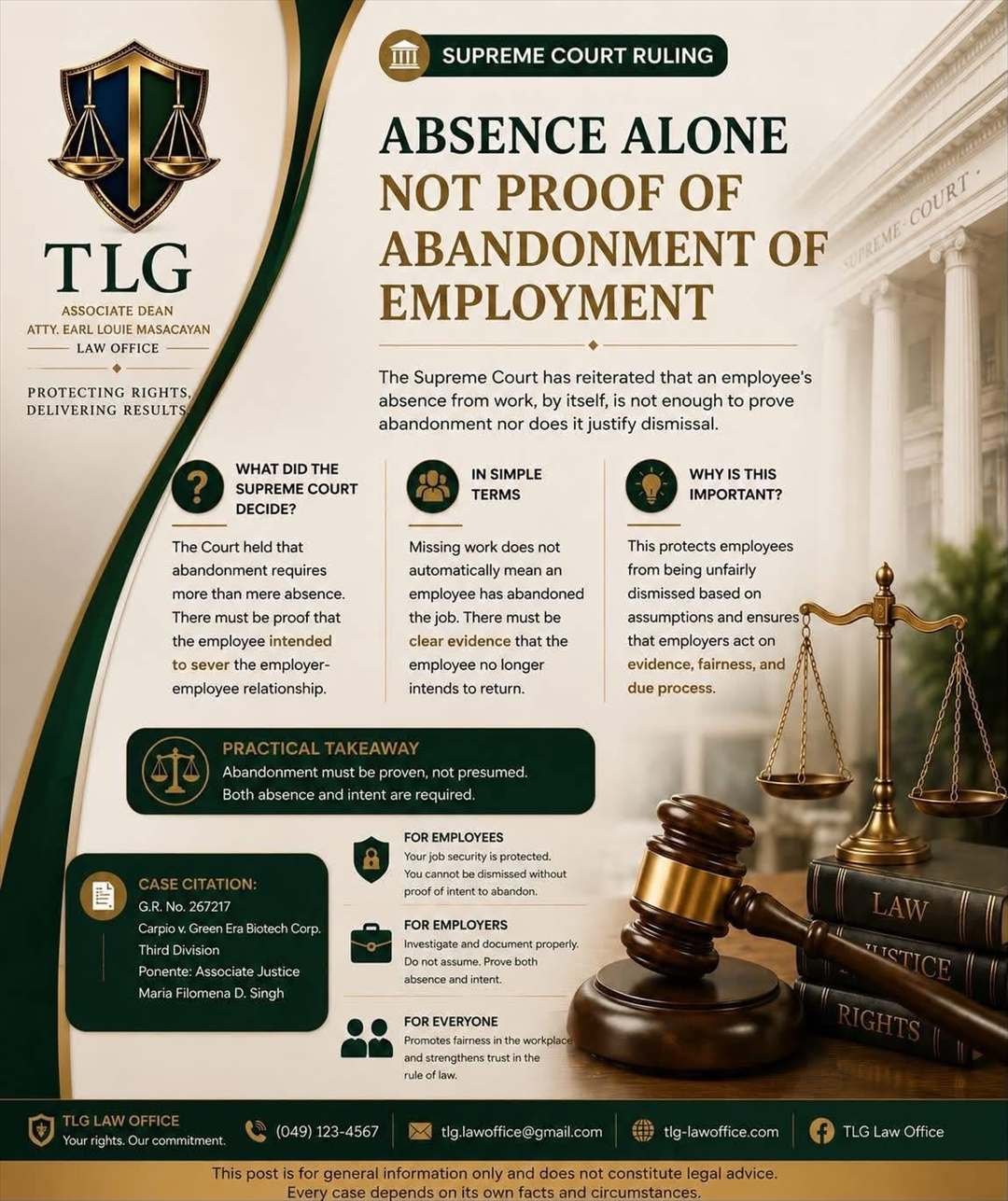
The Supreme Court has reiterated that an employee's absence from work, by itself, is not enough to prove abandonment — nor does it justify dismissal.
What Did the Supreme Court Decide?
The Court held that abandonment requires more than mere absence. There must be proof that the employee intended to sever the employer-employee relationship.
In Simple Terms
Missing work does not automatically mean an employee has abandoned the job. There must be clear evidence that the employee no longer intends to return.
Why Is This Important?
This protects employees from being unfairly dismissed based on assumptions, and ensures that employers act on evidence, fairness, and due process.
Practical Takeaway
Abandonment must be proven, not presumed. Both absence and intent are required.
What This Means for You
- For employees: Your job security is protected. You cannot be dismissed without proof of intent to abandon.
- For employers: Investigate and document properly. Do not assume — prove both absence and intent.
- For everyone: Promotes fairness in the workplace and strengthens trust in the rule of law.
Case Citation
G.R. No. 267217
Carpio v. Green Era Biotech Corp.
Third Division
Ponente: Associate Justice Maria Filomena D. Singh
How TLG Can Help
Were you dismissed for “abandonment” after an absence? Or are you an employer dealing with an employee who stopped reporting for work? We can review the facts and documents and tell you where you stand.
Learn about our Labor & Employment practice →