

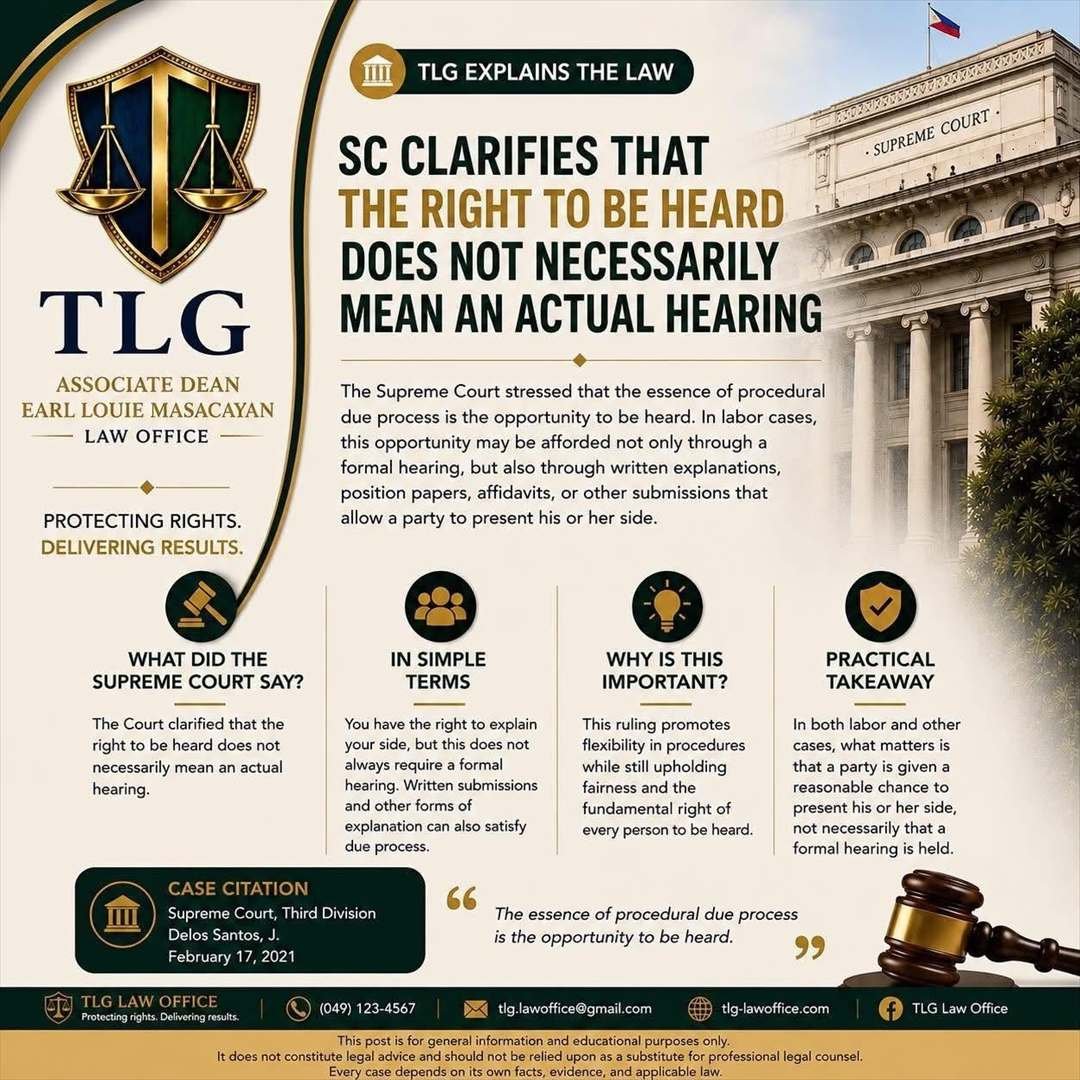
The Supreme Court stressed that the essence of procedural due process is the opportunity to be heard. In labor cases, this opportunity may be afforded not only through a formal hearing, but also through written explanations, position papers, affidavits, or other submissions that allow a party to present his or her side.
“The essence of procedural due process is the opportunity to be heard.”
— Supreme Court
What Did the Supreme Court Decide?
The Court clarified that the right to be heard does not necessarily mean an actual hearing.
In Simple Terms
You have the right to explain your side, but this does not always require a formal hearing. Written submissions and other forms of explanation can also satisfy due process.
Why Is This Important?
This ruling promotes flexibility in procedures while still upholding fairness and the fundamental right of every person to be heard.
Practical Takeaway
In both labor and other cases, what matters is that a party is given a reasonable chance to present his or her side — not necessarily that a formal hearing is held.
Case Citation
Supreme Court, Third Division
Delos Santos, J.
February 17, 2021
How TLG Can Help
Because written submissions can be your only chance to be heard, how you prepare them matters. We help clients prepare clear, complete explanations and position papers.
Learn about our Labor & Employment practice →
Next: SC Upholds DOJ Rules Raising the Standard of Proof in Preliminary Investigations and Inquests